Georgia humidity is what ruins stored goods. Rossville sits in a humid subtropical climate: summers are long, warm, and wet. An uninsulated metal building tracks that weather. It runs hotter than the outside air in the afternoon, then cools at night, and moisture condenses on the coldest surface inside — a tabletop, a television, the back of a picture frame. Repeated from June into September, that cycle loosens wood joints, blooms mildew on fabric, cockles paper, and corrodes electronics from the inside.
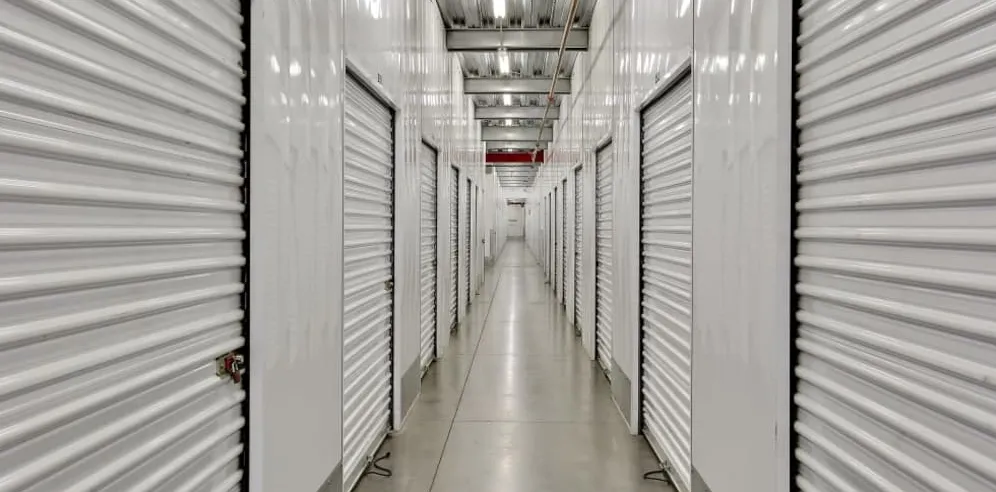
Indoor climate-controlled storage stops the cycle. At 132 Mack Smith Road the climate-controlled units are inside the building. You walk in a door and the units are along a hallway. They are not drive-up. Temperature and humidity are both controlled. Catoosa County Storage has been open since 2001. The office is at 132 Mack Smith Road, Rossville, GA 30741, (706) 858-6498.
What heat and humidity do
Heat alone does not grow mildew. Relative humidity above roughly 60 percent is where mildew starts on fabric, leather, and paper, and the smell does not wash out. Wood takes on moisture when the air is wet and gives it back when the air dries, so across a humid summer and a dry winter glue lines open, veneer lifts, and drawers stick. Warm damp air on a surface that cooled overnight beads into water, and on a circuit board that water is corrosion.
Indoor climate-controlled units are held between 65 and 80°F. That is a temperature range, not a humidity setpoint, and it is not a guarantee that mold will not grow. Humidity is controlled as well. We do not publish a humidity number. Call (706) 858-6498 if you need to ask about a specific item. Theclimate-controlled storage pageis the short version of the same point. Mold, clothes, and pests are answered on thequestions pagewithout a promise that climate control eliminates them.
Wood furniture
Solid wood tables, dressers, chairs, cabinets, and pianos are the clearest reason to rent an indoor climate-controlled unit. Veneer and particle board are more fragile: the face and the core move at different rates, and the glue fails first. Take the drawers out, wrap the piece in a cotton sheet or furniture pad, and do not use a tight plastic tarp — it traps moisture already in the wood. Dry a rain-wet piece in the house before it comes in, and pad corners before you stack anything on it.
Electronics
Televisions, computers, audio gear, and anything with a circuit board should not spend a Georgia summer in an uncontrolled unit. Condensation sits in connectors, and batteries leak in the heat. Take the batteries out, box the device, and keep the box off the floor. Clean and dry refrigerators and washers, prop the doors slightly ajar so the inside cannot grow mold, and secure the doors so they cannot swing into the hallway.
Documents and photographs
Paper and photographs do not recover once humidity has had them. Prints stick to each other and to glass, documents cockle, and ink moves. Tax files, business records, medical records, and photographs you cannot reprint belong in climate control if they have to leave the house. Take photos out of glass frames, store them flat, and skip cardboard that has been sitting in a garage. Plastic boxes are fine when the paper goes in dry.
Instruments
Guitars, violins, pianos, and anything with a wooden soundboard crack and go out of adjustment when humidity swings. A case helps. It does not replace a controlled room through July and August. Loosen string tension a little if the maker says to. Vinyl warps well below the heat an uncontrolled metal unit reaches in August, so store records upright, packed so they cannot lean.
Mattresses and upholstered furniture
Fabric and foam hold damp. A mattress that spends the summer in a humid unit comes back with mildew in the foam. Clean it, make sure it is dry, and use a breathable bag rather than sealed plastic. Do not store one that got rained on. Sofas follow the same rule: vacuum them, dry them, and cover them with a sheet. Climate control does not dry a sofa that went in wet.
How the indoor hallway units work
You park, walk in a door, and the climate-controlled units are along a hallway. Loading is a hand truck or a few trips, not a tailgate at the unit door. That access is why these units can hold an interior climate. The drive-up units on the same property are a separate product: you pull a vehicle to those doors, and they are not climate-controlled. Use them for tools, patio furniture, yard equipment, and building materials. Use the hallway for wood, electronics, paper, instruments, and mattresses. Do not leave goods in the hallway while you sort a load.
Packing so climate control can work
Climate control manages the air. It cannot dry a box you sealed wet.
- Dry everything first. One damp rug in a closed bin will mold the bin.
- Use breathable covers on wood and upholstery. Use plastic bins for paper and small electronics only after those items are dry.
- Keep boxes off the floor where you can, and leave a gap between the stack and the wall so air moves.
- Leave food, candles, and anything that melts or attracts pests at home. Climate control is not a reason to store perishables.
- Keep a box list. Six months later you will not remember which carton holds the photographs.
The sealed container is not climate control
A third option sits alongside the hallway units and is easy to mix up with them. An outside container, 8 feet wide by 20 feet long and 8 feet high. Sealed and dust-free. Not climate-controlled, and not drive-up. It is $100/mo. Rent it when you want a closed, dust-free container and the goods can tolerate North Georgia heat and humidity. Do not put photographs, instruments, mattresses, or solid wood furniture in it and expect climate-controlled conditions. Those belong in the indoor units. Details are on thepricing page.
What the indoor units cost
Indoor climate-controlled rates are 5x10 at $70/mo, 10x10 at $100/mo, 10x20 at $150/mo. The sealed dust-free container is $100/mo. 1st and 2nd month free. $25 one-time admin fee, no security deposit. Month-to-month. A size can be full, so call(706) 858-6498orcheck availabilityand we will quote what is open. Thesize guidewalks through what fits each indoor unit, and the rates sit onunits and pricing:5x10,10x10, and10x20.
Rossville, Fort Oglethorpe, Chattanooga, and Ringgold
The building is at 132 Mack Smith Road, Rossville, GA 30741, about a tenth of a mile north of Cloud Springs Road (GA-146). From Cloud Springs Road (GA-146), go north on Mack Smith Road about a tenth of a mile. The office is on the right, after the second house. Rossville, Fort Oglethorpe, and Ringgold are on the Georgia side. The Tennessee line is about a mile north, so south Chattanooga is a normal drive.Directions from Chattanoogaare written out separately, and thelocation pagehas the same Cloud Springs landmark. Tools can go in a drive-up unit. A dresser should not spend a Georgia summer in one.